
‘Tis the Season
Finding joy in ancient traditions

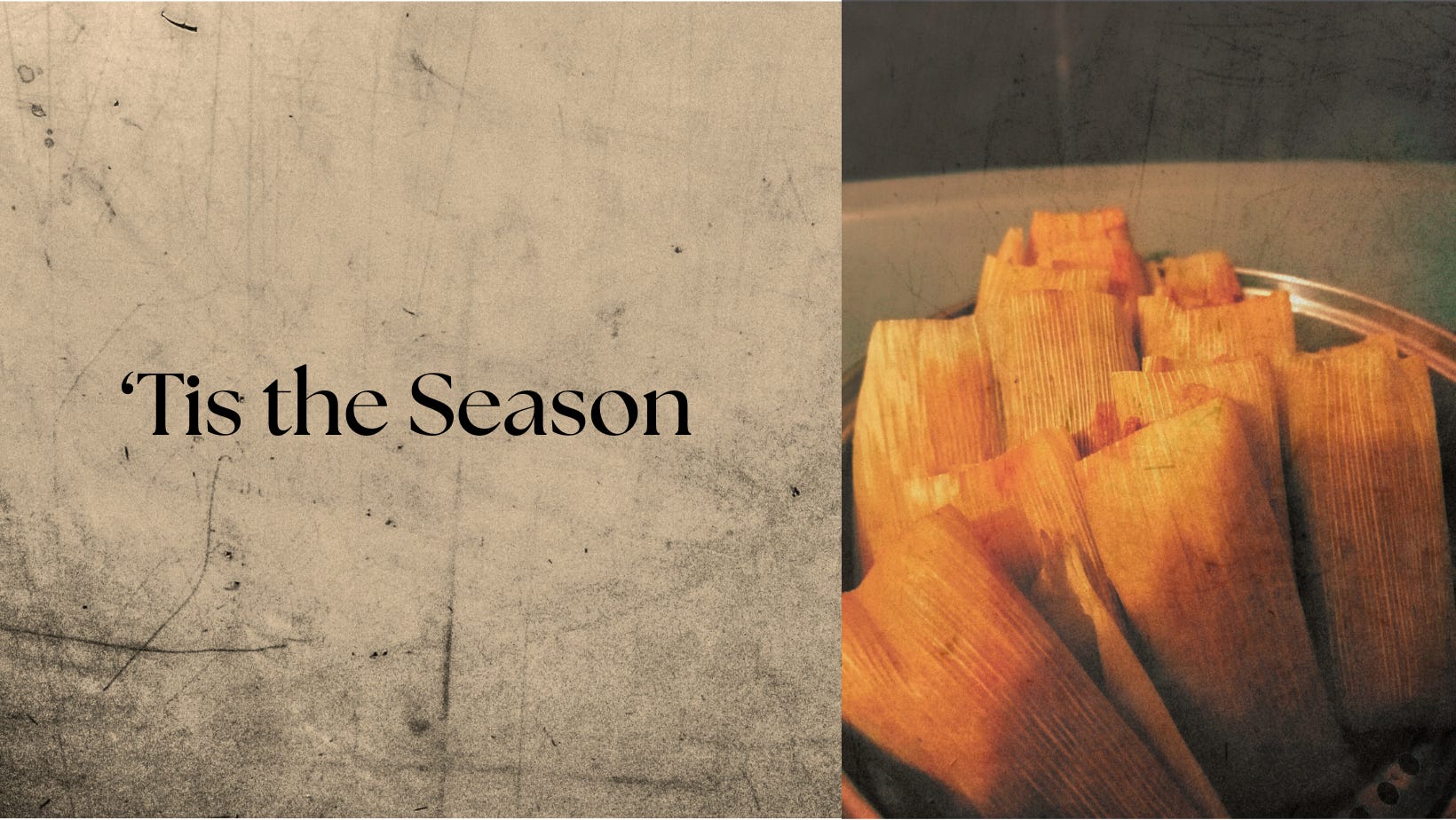
Making tamales is one of my family’s Christmas traditions. We pick a day in December, I spend the week before shopping for groceries and pre-cooking the salsas and fillings, and then we all get together in my parents’ kitchen to make the masa, wrap the tamales, and steam them in giant pots. At the end of it all we’re exhausted, the kitchen is a disaster, and my back and neck are super sore. It means days of work, sinks full of dirty dishes, masa harina flour all over the counters, and fridges and freezers overfilled with food. But the whole house smells like masa, chicken, pork, and chiles, and we get to stuff our faces with tamales, with plenty left over to freeze and eat on Christmas Eve and Christmas Day. And best of all, we spend time together. We talk about our lives, we laugh, we tease each other about our tamal-wrapping skills (or lack thereof), and we compete to see who can wrap the biggest tamal.* And then after all the work is done, we have a delicious feast to enjoy and so many tamales left over, we have to share some with our friends and still end up playing Tetris in our freezers trying to make the rest fit.
One of the coolest things about tamales is how ancient they are. And when I say ancient, I’m not exaggerating. Tamales were created in Mesoamerica as early as 5,000-8,000 years before the birth of Christ. It’s not clear who first created them, the exact year they were invented, or what location or culture they originated from, but archaeological evidence shows that several ancient Mesoamerican cultures included tamales in their cuisine, including the Aztec, Maya, Olmec, and Toltec civilizations. The name of the food is derived from the word tamalli, its name in the Nahuatl language spoken by the Mexica/Aztec people and their modern-day descendants. The methods used to make tamales–nixtamalizing the corn for the flour, making the masa (dough) from the corn flour, filling the masa with meats and a variety of other fillings, wrapping the delicious package with corn husks or plantain leaves, then steaming the tamales in a large pot over boiling water–originated with these ancient cultures and haven’t changed much since. So when people make tamales today, usually using recipes their mothers and grandmothers taught them (which were often passed down to them from their grandmothers’ grandmothers), they’re following the same methods that families have used for thousands of years, going back to some of the first people to live in the Americas.
Today, the tamales most Americans are familiar with are the type commonly made in Mexico, wrapped in corn husks and usually filled with pork or chicken. However, there are hundreds of other possible fillings, including cheese, beans, chile peppers, and even sweet fillings such as pumpkin, chocolate, raisins, and other fruits. One year I had a ton of leftover masa after our usual meat fillings were used up, so my siblings and I filled the leftover dough with random things we found in our parents’ pantry, including chocolate chips, sliced bananas, and pecans. Then we steamed them in one of our giant stockpots, and they were amazing. And while they’re the most common type you’ll find in the United States, Mexican tamales aren’t the only kind available. Multiple Latin American cultures make tamales and put their own spin on the dish, such as nacatamales in Nicaragua, chuchitos in Guatemala, guanimos in the Dominican Republic, hallacas in Venezuela, the pastelle in Trinidad and Tobago, and the dukunu in Belize. Tamales are a nearly universal food in the Americas, and almost every country in this part of the world has found a way to make it their own.
Tamales aren’t just a tasty treat that families get together once a year to enjoy for Christmas. There’s a lot of meaning tied to what looks like a simple (if labor-intensive) dish. Many Mexican families serve tamales during almost every important celebration, including Easter, Día de los Muertos, quinceañeras, weddings, baptisms, and more. Corn, the staple grain of the Americas and the main ingredient in the masa dough used to make tamales, has immense cultural and spiritual importance to many peoples in the Americas. Many cultures’ creation stories involve corn, and some have a deity dedicated to corn. Tamales are portable, and in ancient cultures they were traditionally made for hunting trips, long-distance travel, and as a common food supply in military campaigns. Tamales were also used in religious festivals as offerings or in feasts, and some cultures considered them to be sacred food of the gods.
Women traditionally play a huge role in making tamales. We are usually the ones who buy the ingredients, get everyone organized to help with the cooking, and direct the process from start to finish. We cook the fillings, mix the masa, wrap the tamales, steam them in batches, dish them out to our loved ones, freeze the extras to eat later, and then plan ahead for the next holiday or celebration where we’ll repeat the whole process. We keep our families’ favorite recipes and make sure the tamales turn out just right each year, and then pass our secrets down to our daughters and granddaughters when their time comes. We work for days at a time to make the magic happen, and even though we’re exhausted afterwards and probably complain that we’re going to have to slow down/cut back/quit altogether next year, we do it all over again anyway. Because in spite of the work, we love the results and the time we get to spend with family and with each other. It’s always worth it.
All of this to say, tamales hold a lot of meaning for me and my family. We’re not just making incredibly delicious food. We’re not just carrying on a fun Christmas tradition. We’re not just spending time together as a family. We’re doing all of those things, but we’re doing something more. We’re carrying on a legacy, a tradition going back for thousands of years, so long that no one knows where it really began. It’s as if it’s always been a part of us and our ancestors. Maybe it has.
And in a time when women and girls are once again being told that our only meaningful goal in life should be to stay home and have as many children as possible, we’re passing the legacy of tamales down not just to our daughters and granddaughters, but to our sons and brothers and grandsons too. In a world that has seen cooking as a “womanly” duty, we’re sharing the load as a family, and recognizing that keeping this tradition alive for a new generation is going to take all of us doing our part. We’re carrying the love and labor of generations upon generations of women forward, refusing to let our foremothers’ legacy be forgotten. We’re also refusing to let narrow ideas about men and women dictate how we live our lives. The women of my family have successful careers, brilliant minds, a thirst for knowledge, and a passion for learning. We’re mothers, aunts, and grandmothers, but we’re also social workers, teachers, and business owners. We enjoy cooking and raising our families, but we know our worth isn’t derived from that. We know that we are capable of whatever we put our minds to, and we cheer each other on as we pursue our dreams. We’re taking our foremothers’ legacy and building on it. And we’re keeping what matters most alive: family, connection, joy, and love.
We’re doing all of this, carrying all this weight, in a time when we’re being told that our culture, our heritage, doesn’t belong here. We’re being treated like we’re foreigners, when people like us have lived in this place now called the United States of America for thousands of years before any European explorer knew this place existed. Our ancestors were making tamales before the city of Rome was founded, thousands of years before the Egyptian pyramids were built. We continue to make them today in much the same way they were made back then. We are an ancient people with deep roots in this place. It’s home. It will always be our home. No regime of babbling orange fools can change that. Continuing our legacy, our traditions, our culture is one way to remind everyone that we do belong here, we have always belonged here, and we are proud of the history of our people and our culture. We are not taking something away from America by being here–we are adding our uniquely beautiful legacy to the fabric of this country. We belong here, and we are not going anywhere.
So this year as I get together with my family to make tamales, I’ll be thinking about how many women before me have poured their time, expertise, and love into this food. I’ll be thinking about how their hard work and sacrifice has given me the opportunities I have today. I’ll be thinking about how ancient this food is and how amazing it is that it’s survived so much for so long and remains relatively untouched–and still delicious. I’ll be thinking about all the things tamales mean to my family, and how they have brought us together for thousands of years and will continue to do so for yet another generation. And I’ll be exhausted and covered in masa by the end of it. But I’ll be proud of my hard work to keep this amazing tradition alive. And I’ll be enjoying the delicious results of all that work and the time spent with the people I love. The people who hate my culture and legacy can spend their holidays being bitter and jealous and spiteful and eating who-knows-what (something bland and unseasoned, no doubt). I’ll be spending mine with a full stomach and a full heart, in a house that smells like masa, with the amazing people that I love. And I’ll be enjoying the peaceful, joyous holiday season that my family and I deserve.
*While many English speakers use “tamale” as the singular form of “tamales,” the correct word in Spanish is “tamal,” so that’s the word I use.
Couldn't agree more. Familly traditions are the best kind of delicious chaos.